
A plain-English guide to Performance, Accessibility, Best Practices and SEO, and why each one matters for your business.
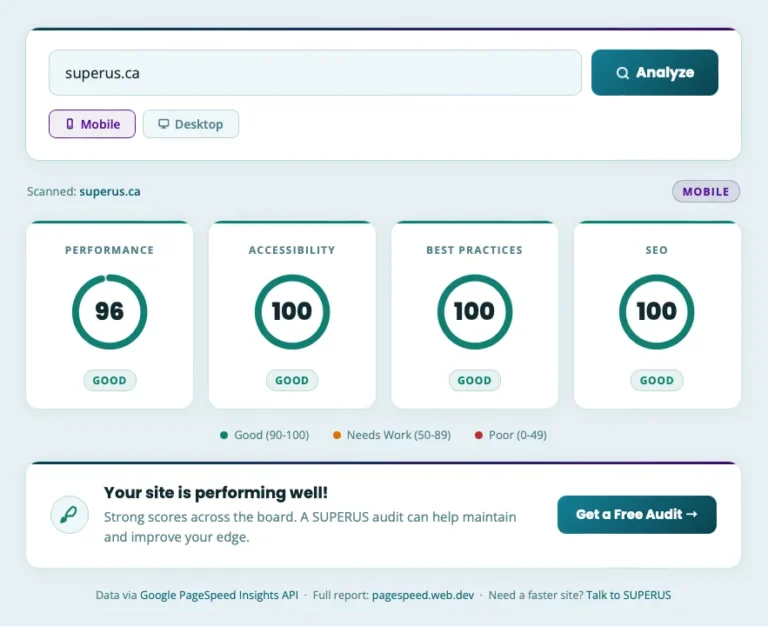
You just ran a website performance check and you’ve got four scores staring back at you. Maybe one is red. Maybe they’re all green. Either way, you’re probably wondering: what do these numbers actually mean, and should I be worried?
As a web design agency focused on accessible, high-performance websites, we see these scores every day across industries, budgets and site types. Here’s what each score is actually measuring, why it matters for your business, and what a good score looks like.
The scoring scale is simple:
This is the big one. Your Performance score measures how quickly your website loads and becomes usable for a real visitor.
Think about the last time you clicked a link and the page took more than three seconds to load. What did you do? You probably hit the back button. Your visitors do the same thing.
Google uses page speed as a direct ranking factor, so slower sites rank lower in search results. Studies consistently show that for every 1-second delay in load time, conversions drop by roughly 7%. On mobile, where most of your visitors are coming from, a slow site feels broken.
A good target: 90+ on desktop, 70+ on mobile (mobile is harder due to slower connections).
Your Accessibility score measures how usable your website is for people with disabilities, including those who are visually impaired, hard of hearing, or who navigate without a mouse.
About 1 in 4 Canadians lives with a disability. That’s a lot of potential customers your site might be turning away without you even knowing.
Beyond reaching more customers, accessibility is increasingly a legal requirement. In Canada, AODA and ACA regulations require accessible digital experiences for many organizations. A low accessibility score is a real liability risk, not just a UX problem.
A good target: 90+ is the baseline. Anything under 80 should be addressed promptly.
This score checks whether your website is following modern web development standards. Think of it as a code health check. It’s less visible than speed or design, but it affects security, reliability, and how search engines trust your site.
A low Best Practices score often means your site has hidden technical problems. These can cause pages to break on certain devices, load third-party scripts that slow everything down, or create security vulnerabilities that put visitors at risk. Google also considers security when determining trust and rankings.
A good target: 95+ is very achievable and should be the standard for any professional website.
Your SEO score measures the technical foundation that helps search engines discover, crawl, and understand your website. This is separate from your overall SEO strategy (keywords, content and backlinks). It’s specifically about whether your site’s basic structure is set up correctly.
Even the best content won’t rank if Google can’t properly read your pages. A low SEO score means you’re essentially leaving the door locked for search engines. They may find you, but they won’t fully understand or trust what they find.
A good target: 90+ is expected for any site serious about appearing in search results.
Google doesn’t just look at one score. It looks at all four together, and so do your visitors, even if they’re not consciously aware of it.
A fast site that’s inaccessible turns away a quarter of your potential customers. A well-structured site with slow load times loses visitors before they even see your content. A site with great content but poor technical SEO never gets found in the first place.
All four scores are interconnected, and improving one often helps the others. That’s why a professional web build considers all of them from the start, not as an afterthought.
If your scores came back lower than you’d like, you’re not alone. Most business websites have at least one area that needs work, and many of these issues are very fixable.
Here’s how we approach each one:
Whatever the issue, we offer a free website estimate so you can see exactly what a fix involves. No jargon, no mystery pricing.
Run your free check, then reach out if you’d like a second set of eyes on what the results mean for your business.
A faster, more accessible and better-built website isn’t just a technical upgrade. It’s a business upgrade.